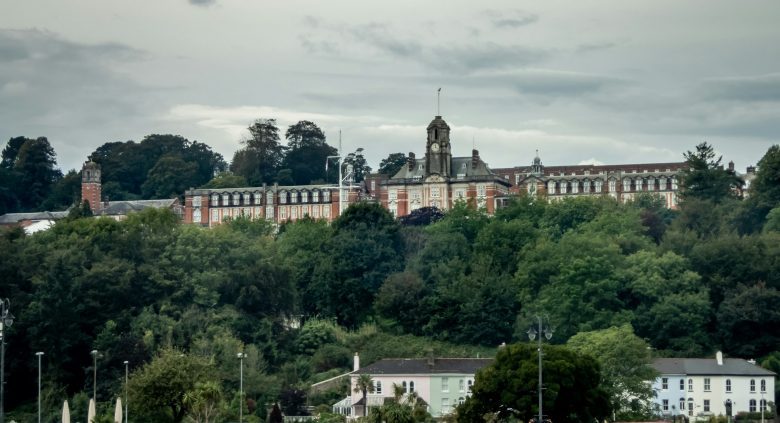
Devon has been fought over, defended and rebuilt for the best part of a thousand years, and the evidence is still standing within an hour or two of Dartmouth. Norman earthworks, a haunted Elizabethan shell, a working family seat on the Exe, and a tower that once served as the county’s most feared courtroom all sit within easy reach of Dartmouth.
1. Dartmouth Castle
Location: Castle Road, Dartmouth
Distance from Dart Marina: approx. 1.5 miles by road, or a short foot ferry from South Town
For over six centuries this castle has guarded the mouth of the Dart, and it began life doing exactly that: construction started in 1388 to keep French raiders out of the harbour during the Hundred Years War.
A century later it was fitted with one of the earliest purpose-built gun towers in Britain, and a great iron chain, first installed in the 1480s, could be raised across the 250-metre estuary mouth to stop enemy ships dead in the water. The castle went on to see action in the Civil War and both world wars, so what you’re walking through is several centuries of coastal defence stacked on top of each other rather than a single moment frozen in time.
Highlights:
- The Gun Tower, with a basement built into the rock where the harbour chain mechanism was housed
- Sound and light installations recreating the Victorian gun battery in use
- Four storeys to climb to an open roof platform with views out to sea
- A passenger ferry from Dartmouth town quay for the classic approach by water (runs from Easter)
2. Totnes Castle
Location: Castle Street, Totnes
Distance from Dart Marina: approx. 9 miles – 20-25 minutes by road
Totnes Castle is about as pure an example of a Norman motte and bailey as survives anywhere in England. It went up around 1087 for Judhael of Brittany, one of William the Conqueror’s men, and its job was never subtlety: a steep man-made mound topped with a stone keep, built to sit over the Anglo-Saxon town and remind everyone who was now in charge. Unusually for a Devon castle, it never saw a siege. It simply declined through the Middle Ages while the town below it got richer, which is why Totnes still has such a good run of 16th and 17th-century buildings on its high street today.
Highlights:
- Over 70 stone steps up the motte to the keep, and a 360-degree wall walk at the top
- Views across the rooftops of Totnes to the River Dart and Dartmoor beyond
- A Holm Oak in the bailey thought to be more than 150 years old
- A walk around the outer ditch and bank, now grown over with wildflowers
3. Berry Pomeroy Castle
Location: Off the A385, near Totnes
Distance from Dart Marina: approx. 8 miles – 20 minutes by road
Berry Pomeroy has a reputation as one of the most haunted castles in England, and it’s easy to see why once you’re standing in the ruins. The Pomeroy family built the original castle here in the late 15th century, then in 1547 it passed to Edward Seymour, Duke of Somerset and uncle to Edward VI.
Seymour was executed for treason within five years of buying it, but his descendants pressed on regardless, building an ambitious Elizabethan mansion inside the old walls that was meant to rival Longleat. The money ran out. The house was never finished, and by 1700 the whole site had been abandoned to the woods, which is exactly the atmosphere that later drew Victorian sightseers and gave rise to the ghost stories that stick to the place today.
Highlights:
- The shell of the unfinished Elizabethan mansion, with its recently uncovered colonnaded loggia
- An audio guide that covers both the history and the ghost stories, so you can take either as seriously as you like
- Woodland walks from the car park giving views of the ruins from below
- A rare wall painting of the Adoration of the Magi, one of the earliest English depictions to include a Black Wise Man
4. Compton Castle
Location: Marldon, near Paignton
Distance from Dart Marina: approx. 13 miles | 30-35 minutes by road
Compton Castle has belonged to one family, the Gilberts, for close to 600 years, with a gap of about a century when it fell into disrepair before a descendant bought it back in 1931. The fortified front you see today was added around 1520, but the family’s most famous member is Sir Humphrey Gilbert, half-brother to Sir Walter Raleigh, who sailed from Devon to claim Newfoundland for Elizabeth I in 1583, one of the earliest English footholds in North America.
Local tradition holds that Raleigh smoked his first pipe of tobacco on English soil during a visit here. The castle is still lived in by the Gilbert family today, which gives the rooms a different feel to a pure museum piece.
Highlights:
- The Great Hall, with a model of the Squirrel, the ship Sir Humphrey Gilbert sailed to Newfoundland
- The Solar, reached by a 15th-century staircase, once the family’s private retreat from the noise of the hall
- High curtain walls, towers and a working portcullis
- A small medieval-style knot garden and rose garden

5. Powderham Castle
Location: Kenton, near Exeter
Distance from Dart Marina: approx. 42 miles – 1 hour 15 minutes by road
Powderham has been the Courtenay family seat since Sir Philip Courtenay began building it in 1391, and it’s still lived in by the current Earl and Countess of Devon today, the 28th generation to call it home.
That continuity is unusual even by English country house standards. The building has been fought over and rebuilt more than once: Parliamentarian troops stormed it in January 1646 during the Civil War, causing serious damage, and what stands today is really a layering of medieval core, Georgian remodelling and a striking Victorian Gothic gatehouse and dining hall added by the architect Charles Fowler in the 19th century.
Highlights:
- The Marble Hall, completed in 1755 with its black and white marble floor
- Guided castle tours through rooms shaped by six centuries of the same family
- The Belvedere Tower and an American Garden in the grounds
- A deer park running down to the Exe estuary, with pony grooming and alpaca walking for families
6. Okehampton Castle
Location: Castle Lane, Okehampton
Distance from Dart Marina: approx. 53 miles – 1 hour 30 minutes by road
This is the largest castle in Devon, built soon after the Norman Conquest by Baldwin FitzGilbert on a wooded spur above the West Okement river. It stayed a working fortress for a couple of centuries before Hugh Courtenay, Earl of Devon, converted it into a luxury hunting retreat in the 14th century, complete with its own deer park.
The Courtenays’ luck ran out in 1539, when Henry Courtenay, Marquis of Exeter, was executed for plotting against Henry VIII and most of the family’s estates, this castle included, were confiscated by the Crown. It has been a ruin ever since, and a picturesque one: the 18th-century Romantic painter J.M.W. Turner was among the artists drawn to sketch it.
Highlights:
- The keep mound, doubled in size during the 14th-century rebuild
- Woodland and riverside walks along the West Okement
- Wildflower meadows in spring and early summer, and regular birdlife
- A picnic area by the river for a stop between Dartmoor walks
7. Bickleigh Castle
Location: Bickleigh, near Tiverton
Distance from Dart Marina: approx. 50 miles – 1 hour 30 minutes by road
Bickleigh Castle is smaller in scale than the name suggests, and mostly what survives is the gatehouse and a chapel, but the chapel is the real draw: parts of it date back to around AD 600, and it’s often described as the oldest complete building in Devon.
A Norman motte castle stood here in the 11th and 12th centuries before the Courtenay family, who also held Powderham and Okehampton, rebuilt the site as a fortified manor in the 15th century. It later passed to the Carew family, was badly damaged by Parliamentary troops in 1646, and spent a long stretch as a working farm before restoration in the 1920s and 30s brought it back. Note that this is a private estate, open to visitors on a more limited schedule than the English Heritage and National Trust sites on this list.
Highlights:
- The Saxon chapel, with a 1550s carved overmantel depicting the trial and execution of Henry Courtenay
- The 12th-century gatehouse, Grade I listed
- A reputed underground passage linking the Old Court to the gatehouse
- Afternoon tea in the Orangery or gardens after your tour
Note: Bickleigh Castle currently opens to the public on Thursday afternoons only, from early April to late October. Check their website for further details.
Planning Your Castle Day
Timing: Dartmouth Castle, Totnes Castle and Berry Pomeroy can all be combined in a single day without much driving, since none of them is more than half an hour from the hotel.
Combining visits: Powderham, Okehampton and Bickleigh are all roughly an hour to ninety minutes out, so pick one per day trip rather than trying to chain them together.
Ghost hunters: Berry Pomeroy and Okehampton (home to the legend of Lady Howard) both have local ghost stories attached, if that’s the angle you want to build a visit around.
Families: Compton Castle and Powderham both run trails, dressing-up and hands-on activities alongside the history, which makes them the easier sell for children.
Check before you go: English Heritage sites (Dartmouth, Totnes, Berry Pomeroy, Okehampton, Lydford) generally have wider opening seasons than the privately run properties. Bickleigh in particular has very limited public opening, so this needs checking directly with each site before publishing.
With all of this Devon history to explore, you’ll be needing a place to stay. Dart Marina is a four star luxury hotel settled on the bank of the River Dart. For history lovers, it’s hometown of Dartmouth offers visitors an excellent opportunity to soak up some more history and learn more about the surrounding area.